
6 min read · Continuous Improvement
You trained the team. You ran the DMAIC project. You celebrated the results at a town hall. Six months later the problem is back, and nobody can explain why. If that sounds familiar, you are not alone.
This is the most common Lean Six Sigma failure mode in manufacturing, and it almost never has anything to do with statistics or methodology. It comes down to ownership. Specifically, the absence of it once the project closes.
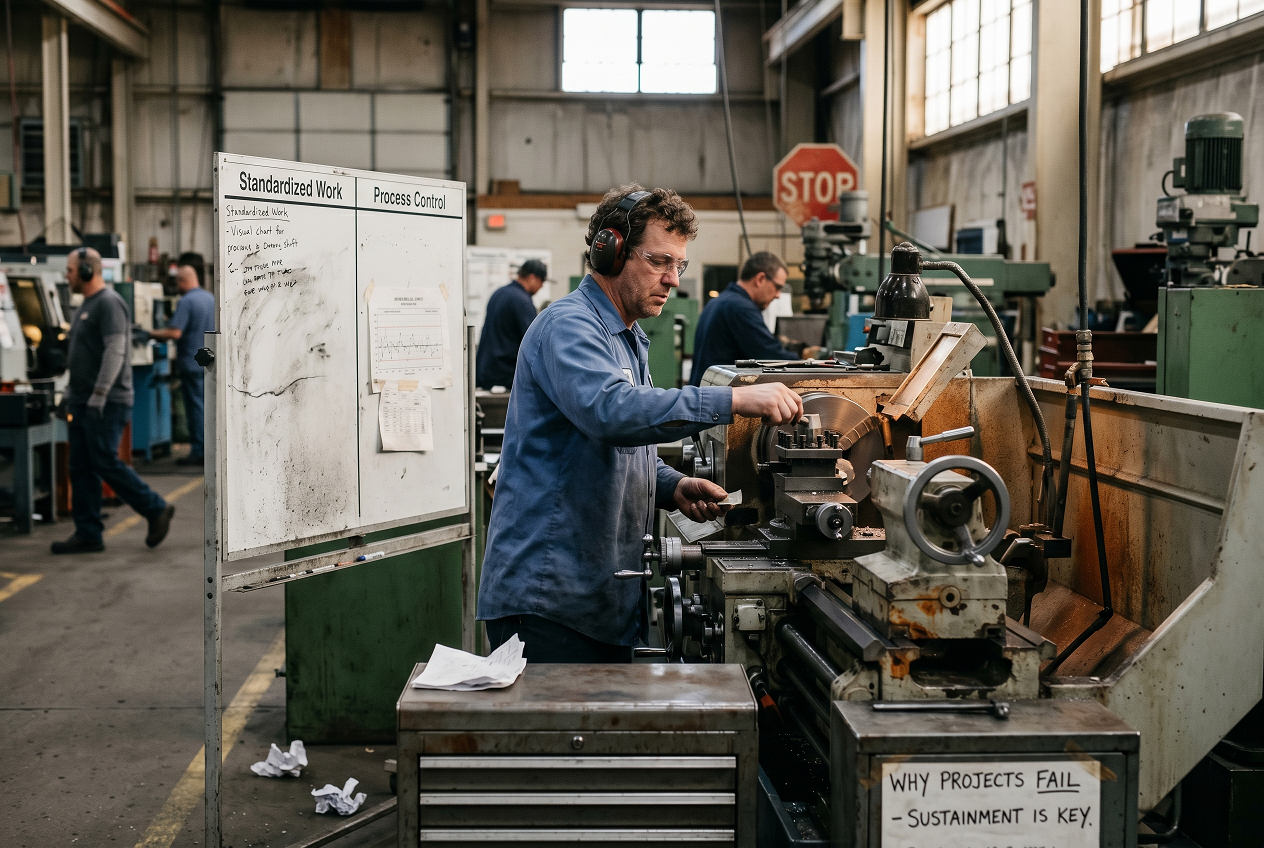
LSS projects are typically led by engineers or quality managers who identify the root cause, design the fix, implement the controls, and then hand everything off to the operators running the line. The standard gets updated, the SOP gets posted, and a control chart gets taped to the machine. Then slowly, over weeks and months, the old way creeps back in. Not out of malice. Out of habit, production pressure, and the quiet absence of anyone checking.
70%of process gains lost within 12 months
#1cause: lack of operator ownership
5×ROI when control phase is sustained
“Without a standard there can be no improvement.”
Taiichi Ohno, father of the Toyota Production System
Ohno’s point is often quoted to justify documentation. But there is a deeper meaning in it. A standard that nobody believes in and nobody owns is not a standard. It is wallpaper. The document can be perfect and the process will still drift. What sustains a standard is the person who is accountable for it day after day.
The fix is structural, and it starts before the project closes. In your DMAIC Control phase, define who owns each control measure by name, not by role title. Build a 30, 60, and 90 day review cadence directly into the project charter. Make the process owner, not the Black Belt, responsible for presenting results at each review. When the operator running the line is the one reporting progress to management, the dynamic changes completely.
It also helps to involve the line team earlier in the process, ideally during the Analyze and Improve phases. When people help design the solution, they defend it. When they simply inherit it, they tolerate it until the pressure to revert becomes too strong.
Lean Six Sigma is a powerful toolkit. But tools do not hold gains. People do. Design your projects so the people closest to the process feel like they built the solution. That is the only control mechanism that never drifts.