
6 min read · Operations
2–5%avg scrap rate in manufacturing
$46Bannual scrap cost in US industry
3–4×true cost vs. raw material value
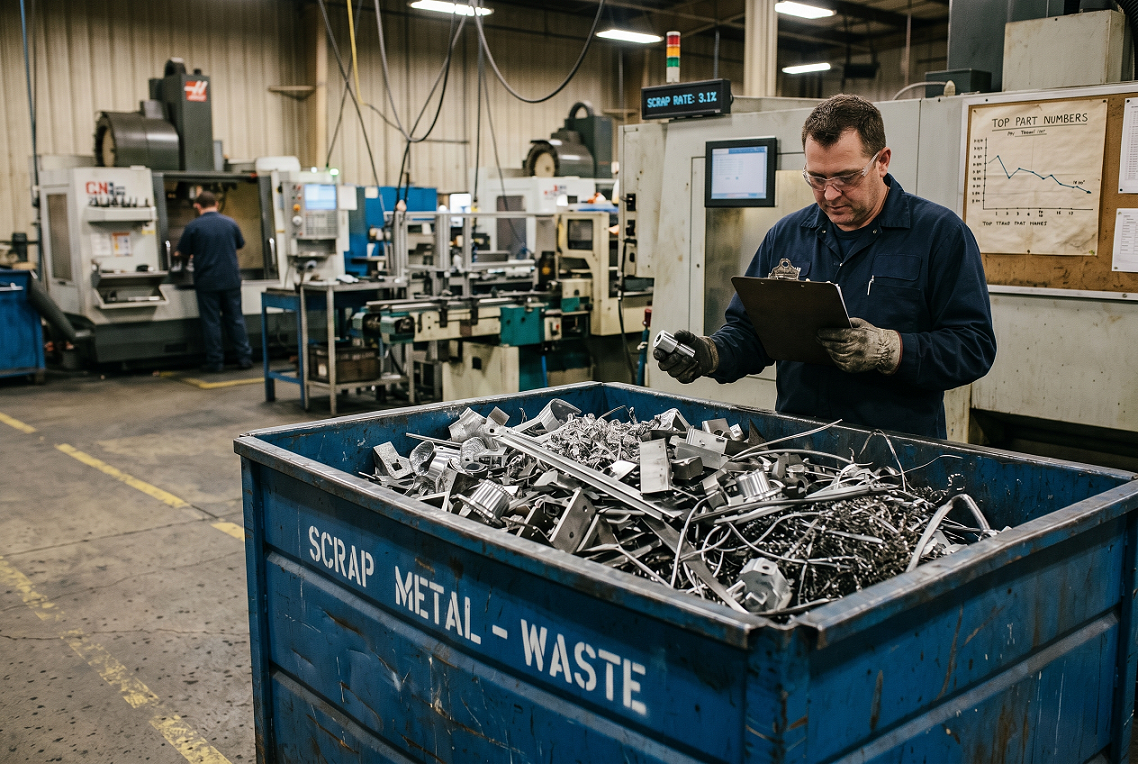
Most manufacturing leaders track scrap as a percentage. Very few actually feel its true weight. That 3% scrap rate sitting on your daily report is not just wasted material. It is wasted labor, wasted energy, wasted machine time, and wasted floor space storing the rejected parts that pile up before anyone carts them away. And yet, in most plants, scrap gets a line on a dashboard and very little else.
The first step toward fixing it is measuring it correctly. Break scrap down into three categories: design-driven scrap comes from specs that are inherently difficult to produce consistently. Process-driven scrap comes from variation baked into your equipment or methods. Operator-driven scrap comes from inconsistency introduced by human decisions in the moment. Each category has a different root cause and a completely different solution. Combining them into a single percentage produces a useless average that hides exactly where your money is going.
Once you have categorized the scrap, assign a true cost per rejected part. Not just the material value. Include the fully loaded labor and overhead that went into that part before it was rejected. In most shops, that number lands at three to four times the raw material value. When leadership sees the real figure, priorities shift quickly. A two-dollar part that gets scrapped after four operations is not a two-dollar loss. It is closer to eight or ten.
“If you can’t describe what you are doing as a process, you don’t know what you’re doing.”
W. Edwards Deming, quality management pioneer
That quote cuts to the heart of the problem. Most plants tolerate chronic scrap not because they lack the capability to fix it, but because the process generating it has never been clearly defined or measured. You cannot reduce what you have not precisely described.
Start with your top three part numbers by scrap volume this quarter. Map every process step, identify exactly where the rejection occurs, and ask why at least five times before accepting an answer. In most cases, you will find that 60 to 70 percent of your total scrap cost is concentrated in a small number of recurring failure modes. And most of them are fixable without capital investment.
Scrap is not a tax on manufacturing. It is a signal. The plants that treat it as information and act on it systematically are the ones that eventually stop paying it.